
What Are Crystal Dice? Quartz, Amethyst and Rose Quartz Explained
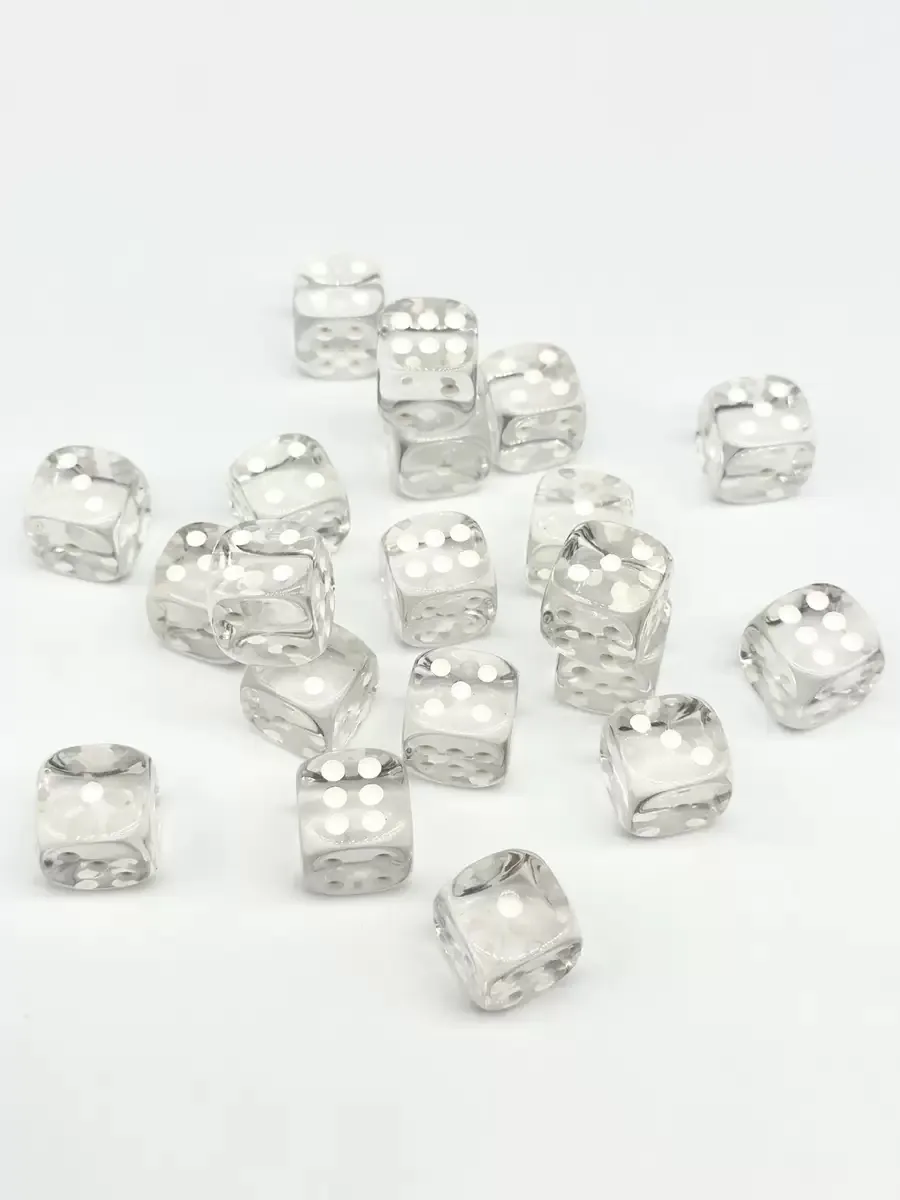
Crystal dice are gemstone dice made from the translucent quartz family: clear quartz, amethyst and rose quartz. Gemstone dice is the wider term and includes opaque stones such as obsidian, tiger eye, lapis lazuli and turquoise. The practical difference is light. Because light passes through a crystal die, every internal veil and fracture is visible from every angle, so blanks have to be graded harder and yield per block is lower. Engraving reads by ink contrast rather than by shadow, colour is banded and uneven within a single die, and quartz at about 7 on the Mohs scale holds a crisp edge but can still chip on a hard drop. Colour is not selectable — the stone is the colour, so you pick a stone and we match you to the closest one we cut.
People shopping for stone dice use "crystal dice" and "gemstone dice" more or less interchangeably, and most of the time it does not matter. When you are placing an order it starts to matter, because the two terms describe different parts of the same range and they behave differently in production.
What is the difference between crystal dice and gemstone dice?
Gemstone dice is the umbrella term for any die cut from natural stone. Crystal dice are the subset you can see through — in practice the quartz family. Clear quartz, amethyst and rose quartz are crystal dice. Obsidian, tiger eye, lapis lazuli, turquoise, green aventurine and agate are gemstone dice but not crystal dice, because light stops at the surface. Both are real stone; neither is a grade above the other. They are just different materials with different behaviour.
Why translucency changes the manufacturing
On an opaque stone, a small internal flaw sits under the surface and nobody ever sees it. On clear quartz there is no under-the-surface. A veil, a healed fracture, a mineral inclusion — all of it is visible from every angle and becomes part of the finished die. That means crystal blanks get graded harder than opaque ones, more raw material is rejected before cutting, and the usable yield per block is lower. It is the main reason a clear quartz set and an aventurine set of the same size are not the same job.
Engraving works differently on see-through stone
An engraved numeral on opaque stone is legible because the cut catches a shadow. On translucent stone there is no shadow to catch — light comes through from behind the cut and flattens it. The ink fill is what makes a crystal die readable, not the engraving itself. That pushes two decisions forward: the fill colour has to be chosen for contrast against the actual stone rather than against your brand palette, and very fine numerals or symbols that would survive on obsidian can vanish on clear quartz once filled.
Expect variation, and expect it inside a single die
- Colour is banded — one amethyst die commonly runs from pale lilac to deep violet across its faces.
- No two sets match, and no two dice within a set match exactly.
- Rose quartz is typically cloudier than clear quartz; that cloudiness is characteristic, not a flaw.
- Clear quartz is rarely perfectly clear — most natural material carries some veiling.
- If a buyer expects twelve identical sets, crystal is the wrong material and a good factory will say so before the order.
How durable are crystal dice?
Quartz sits at about 7 on the Mohs hardness scale. That is hard — it holds a crisp faceted edge, resists scratching far better than resin, and will not scuff in a dice bag. It is still a crystal, though, and crystals are brittle. A corner landing on a hard table can chip one, and no finishing process changes that. This is why stone dice are usually sold alongside a tray or a soft rolling surface, and why packing for the freight leg matters more than it does for resin.
Can you choose the colour?
Not the way you can with resin, where pigment is mixed to a target. With natural crystal the colour is the material itself. What you choose is a stone. In practice the conversation runs the other way round from what buyers expect: you describe the shade you are after, and we tell you which of the stones we cut comes closest, then send photographs of the actual blanks before anything is produced. It is a real constraint, but it has a clean answer and it is far better to establish it before an order than after.
What you can specify
Plenty, once colour is off the table. The stone, the die sizes and which polyhedrals are in the set, the numeral font or a custom symbol set, a logo, the ink fill colour, and the packaging. On a 16mm die you have roughly 10 to 12mm of usable face, so bold solid shapes survive and fine detail does not — the same rule as any engraved die, just less forgiving on translucent material.
Ordering
Our minimum is 10 sets across the whole stone range, crystal included, and lead time runs 3 to 6 weeks depending on quantity and how much engraving work is involved. You can order a single fully custom sample first to see the stone, the engraving and the packaging in hand, with the sample fee credited against the first bulk order. Shipping is EXW, FOB or CIF from Dongguan; we do not offer DDP, so import duty and clearance are the buyer’s side of the transaction.
Frequently asked questions
What is the difference between crystal dice and gemstone dice?
Crystal dice are the translucent quartz-family subset — clear quartz, amethyst, rose quartz. Gemstone dice is the wider term and also covers opaque stones like obsidian, tiger eye, lapis lazuli and turquoise. The difference is whether light passes through the finished die.
Are crystal dice made of real crystal or glass?
Real crystal dice are cut from natural quartz. Glass dice are moulded and will show bubbles, perfectly even colour and no internal veiling. Natural quartz shows banding, inclusions and variation between dice in the same set — if every die looks identical, it is probably not stone.
Can I pick the colour of crystal dice?
No, not in the way you can with resin. The colour is the material. Tell us the shade you want and we will match you to the closest stone we cut, then send photographs of the actual blanks before production.
Do crystal dice chip easily?
Quartz is about 7 on the Mohs scale, so it is hard and holds a crisp edge, but it is brittle like any crystal. A corner drop onto a hard surface can chip one. Sell them with a tray or soft rolling surface.
Why do crystal dice cost more than opaque stone dice?
Because every internal flaw is visible, blanks are graded harder and more raw material is rejected, so the usable yield per block is lower. The cutting and polishing time is similar; the material loss is not.
What is the minimum order for custom crystal dice?
Ten sets. You can order one fully custom sample first to evaluate stone, engraving and packaging, and the sample fee is credited against your first bulk order.
Related guides
Have a custom dice project?
Send us your spec sheet — we'll reply with a detailed quote within 24 hours.
Get a Free Quote