
How to Tell Real Crystal Dice from Glass
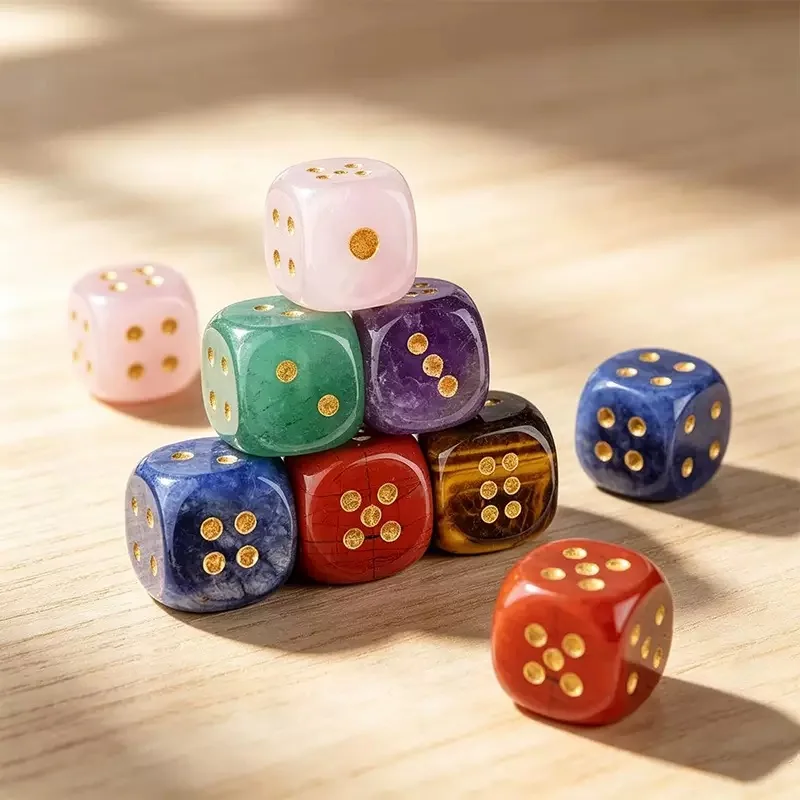
Moulded glass is regularly sold as crystal, and the differences are visible once you know what to look for. Natural stone shows variation between dice in the same set, internal banding and inclusions, and mineral-specific colour; glass shows perfectly even colour, occasional round bubbles, mould seams and sometimes a lighter feel. Uniformity is the strongest single signal — natural stone cannot produce twelve identical dice, and a supplier who promises it is either selling glass or has not understood the question. Glass dice are not a scam in themselves; crackle glass and opalite are legitimate materials with their own look. The problem is only when they are described as gemstone.
We cut natural stone and we also make crackle glass and opalite designs, so we see this from both sides. Glass dice are a legitimate product with a look of their own. What causes trouble is glass sold under a stone name, and buyers who have no way to check.
Check one: how similar are the dice to each other?
This is the strongest test and it needs no equipment. Line up the seven dice in the set and compare them. Natural stone is quarried in blocks with their own banding and colour, so dice cut from the same block still differ, and a set will show a visible range. Glass is moulded from a controlled batch and comes out uniform. If all seven dice are the same shade with the same internal pattern, you are almost certainly looking at glass. Natural stone cannot do identical, and any supplier promising perfectly matched stone sets is either quoting glass or has misunderstood what was asked.
Check two: look inside
- Natural stone shows veils, healed fractures, mineral inclusions and directional banding.
- Glass shows round or teardrop bubbles — stone does not form spherical voids.
- Crackle glass shows a deliberate internal fracture network that is far more even than natural fracturing.
- Opalite shows a characteristic blue-white glow against dark backgrounds and an orange cast against light; it is a man-made glass, and a good supplier says so.
Check three: the edges and seams
Stone dice are cut and ground, so faces are flat and edges are crisp where the grinding stops. Moulded glass carries seam lines where the mould halves met, usually faint and running around the die, and the edges are often very slightly rounded from the mould rather than from a grinding pass. Tilt the die under a light and look along the edge rather than at the face.
Check four: weight and temperature
These are weaker tests and worth knowing the limits of. Most gemstones are denser than glass, so a stone die usually feels heavier than a glass die of the same size, but the difference is not dramatic and it is unreliable without something to compare against. Stone also tends to stay cool against the skin slightly longer than glass. Treat both as supporting signals rather than proof — they help confirm what the visual checks already suggested.
Check five: what is the supplier willing to say?
Ask directly what the material is, and ask for photographs of the actual blanks or the actual batch rather than a catalogue render. A factory that cuts stone can answer immediately, name the stone, and show you raw material. Vague answers, stock photography, or a price that undercuts every other quote by a wide margin are all worth pausing on. Stone has material cost and yield loss built into it; glass does not, which is exactly why the two cannot cost the same.
Glass is not the enemy
None of this means glass dice are bad. Crackle glass has a look natural stone cannot reproduce, opalite has a glow people genuinely want, and both cost less and come out consistent, which matters if a retailer needs matched stock. We make them. The only real problem is a description that does not match the material, because a buyer who paid for amethyst and received purple glass has been sold something they did not choose.
If you are buying wholesale
Put the material in writing on the purchase order, stone by stone, and ask for photographs of the production batch before it ships rather than after. If you are reselling, say plainly on your own listing which items are natural stone and which are glass. It costs nothing, it prevents the return that follows a customer discovering it themselves, and it is the single easiest way to build the kind of trust that brings buyers back.
Frequently asked questions
How can I tell if crystal dice are real stone?
Compare the dice in the set to each other. Natural stone shows visible variation in colour and internal pattern between dice; moulded glass comes out uniform. Also look for round bubbles, which glass has and stone does not, and for mould seam lines along the edges.
Do real crystal dice have bubbles inside?
No. Spherical or teardrop bubbles are a glass feature. Natural stone shows veils, healed fractures, mineral inclusions and banding, but not round voids.
Is opalite a real crystal?
No, opalite is a man-made glass. It has a distinctive blue-white glow and is a legitimate material, but it is not a natural stone and should not be sold as one.
Are glass dice worse than stone dice?
Not worse, different. Glass is consistent, cheaper and can produce looks natural stone cannot, such as crackle. The problem is only when glass is described as gemstone.
Can a stone dice set be perfectly matched?
No. Natural stone varies between blocks and within a single block, so a set always shows a range. A supplier promising perfectly matched stone sets is either quoting glass or has misunderstood the request.
How do I protect myself when ordering wholesale?
Name the material stone by stone on the purchase order and ask for photographs of the actual production batch before it ships, not catalogue renders. A factory that cuts stone can supply those immediately.
Related guides
Have a custom dice project?
Send us your spec sheet — we'll reply with a detailed quote within 24 hours.
Get a Free Quote