
Dice Notation and Probability Explained: 2d6, d100 and Advantage
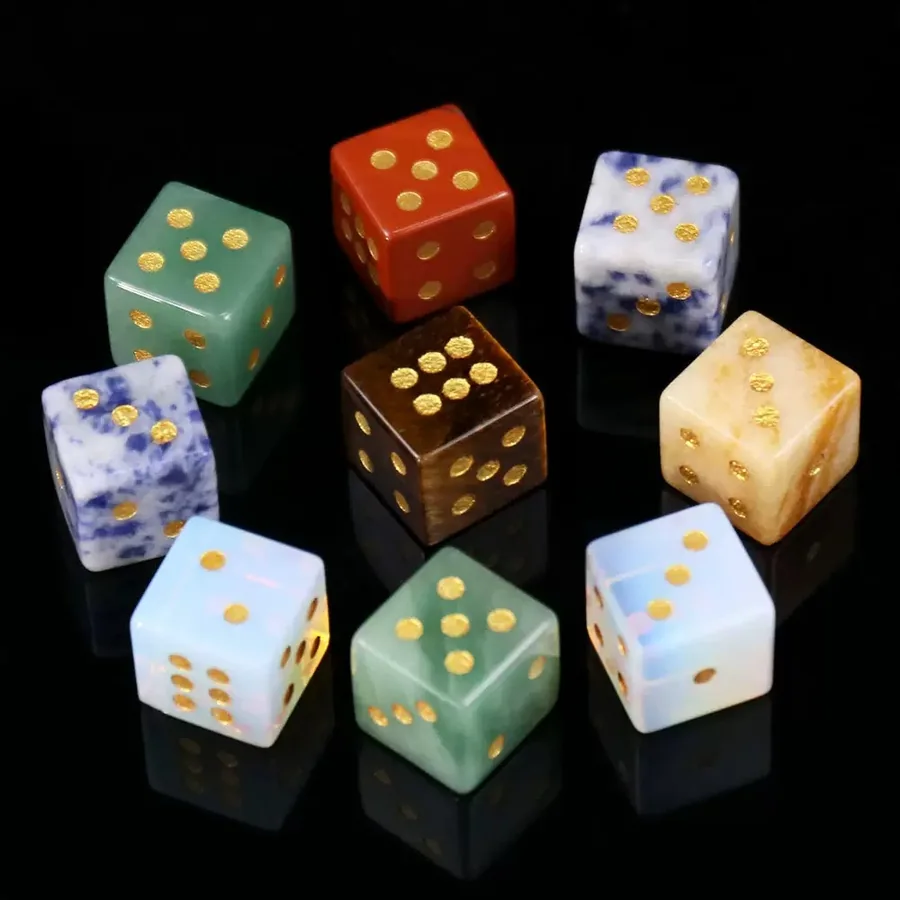
Dice notation reads XdY+Z: roll X dice with Y sides and add Z, so 2d6+3 means roll two six-sided dice and add three. The average of a single die is (Y+1)/2, so a d20 averages 10.5 and a d6 averages 3.5. The important distinction is that a single die is flat — every face equally likely — while multiple dice form a bell curve, so 2d6 averages 7 and lands near 7 far more often than 1d12 lands near its average of 6.5. Advantage in D&D, rolling two d20 and keeping the higher, raises the average from 10.5 to about 13.8 and roughly doubles your chance of a natural 20 to 9.75 percent.
Most dice questions people ask are really probability questions in disguise: why does this system use 2d6 instead of a d12, is advantage as strong as it feels, what are my odds of a natural 20. The notation is simple once explained, and the maths behind it changes how games feel to play.
How do you read dice notation?
The format is XdY+Z. X is how many dice you roll, Y is how many sides each has, and Z is a flat number added afterwards. So 2d6+3 means roll two six-sided dice, total them, add three — a result between 5 and 15. A d20 alone is 1d20, usually written just d20. A minus works the same way: 1d8-1 gives 0 to 7. Percentile is written d100 or d%, and is rolled with two ten-sided dice.
What is the average roll?
- A single die averages (Y+1)/2 — so d4 is 2.5, d6 is 3.5, d8 is 4.5, d10 is 5.5, d12 is 6.5, d20 is 10.5.
- Multiple dice simply multiply that: 2d6 averages 7, 3d6 averages 10.5, 8d6 averages 28.
- Add the modifier last: 2d6+3 averages 10.
- This is the fastest sanity check in game design — if a weapon should do about 10 damage, 2d6+3 gets you there.
Why 2d6 is not the same as 1d12
Both produce numbers in roughly the same range, but they behave completely differently. A d12 is flat: every result from 1 to 12 is equally likely, a 1 in 12 chance each. Two d6 form a bell curve, because there are more ways to make a middle number than an extreme one. There is exactly one way to roll 2 (snake eyes) and one way to roll 12, but six ways to roll 7 — so 7 comes up about 16.7 percent of the time while 2 and 12 each appear under 3 percent. In play, 2d6 feels reliable and 1d12 feels wild. Game designers choose between them precisely for that reason.
How do percentile dice work?
A d100 roll uses two ten-sided dice: one marked in tens (00, 10, 20 up to 90) and one marked 0 to 9. Read the tens die first, then the units die, so 40 and 7 gives 47. The special case is 00 and 0, which reads as 100 rather than zero. If you only have two ordinary d10, nominate one as the tens die before rolling — the convention matters more than the dice themselves. Call of Cthulhu, older editions of D&D and many percentile systems run on this.
What does advantage actually do?
Advantage in D&D 5e means rolling two d20 and keeping the higher; disadvantage keeps the lower. It is stronger than most players assume. A plain d20 averages 10.5. With advantage the average rises to about 13.8, and with disadvantage it falls to about 7.2 — a swing of roughly six and a half points between the two states. Your chance of a natural 20 goes from 5 percent to 9.75 percent, because you only miss if both dice avoid it. Advantage helps most in the middle of the range: if you need a 10 or better, it lifts you from about 55 percent to around 80 percent, while a target you could only hit on a 20 stays hard.
Rolling ability scores: 4d6 drop lowest
The classic method is to roll four six-sided dice and discard the lowest, which averages about 12.24 rather than the 10.5 of 3d6. That is why characters rolled this way come out noticeably stronger than a flat 3d6 array, and why the standard point-buy alternative exists. It is also a neat illustration of the general principle: rolling extra dice and discarding the worst shifts the whole distribution upward without changing the possible range.
Dice pools work differently again
Systems like Shadowrun and World of Darkness do not total the dice. You roll a handful and count how many beat a target number, so the result is a number of successes rather than a sum. Adding a die to a pool adds a fixed chance of one more success — much more predictable than adding a die to a total. That is why pool systems scale smoothly with character skill and why they use many identical dice rather than a mixed polyhedral set.
Does the material change the odds?
Not meaningfully, for any hobby die. What matters for fairness is accurate flat faces and even geometry, which is a manufacturing question rather than a material one. Stone, metal and plastic dice are all gaming grade rather than casino grade, and casino dice are held to tolerances measured in thousandths of an inch precisely because that standard is not required at a kitchen table. In practice no player will detect a difference across a normal game — the dice you roll matter far less than whether you are rolling 2d6 or 1d12.
Frequently asked questions
What does 2d6+3 mean?
Roll two six-sided dice, add them together, then add three. The notation is XdY+Z: X dice with Y sides, plus a flat modifier Z. The result ranges from 5 to 15 and averages 10.
What is the average roll on a d20?
10.5. The average of any single die is (Y+1)/2, so a d6 averages 3.5, a d12 averages 6.5 and a d20 averages 10.5.
Is 2d6 the same as 1d12?
No. A d12 is flat — every result equally likely. 2d6 forms a bell curve: 7 comes up about 16.7 percent of the time while 2 and 12 each appear under 3 percent. 2d6 feels reliable, 1d12 feels swingy.
How much does advantage help in D&D?
It raises the average d20 result from 10.5 to about 13.8 and takes your chance of a natural 20 from 5 percent to 9.75 percent. It helps most on middling targets — needing a 10 or better goes from roughly 55 percent to around 80 percent.
How do you roll d100?
With two ten-sided dice: one marked in tens (00 to 90) and one marked 0 to 9. Read tens first, so 40 and 7 gives 47. A roll of 00 and 0 reads as 100.
Do gemstone dice roll differently from plastic?
Not meaningfully. Fairness depends on accurate flat faces and even geometry rather than material. All hobby dice, whatever they are made of, are gaming grade rather than casino grade.
Related guides
Have a custom dice project?
Send us your spec sheet — we'll reply with a detailed quote within 24 hours.
Get a Free Quote