
What Dice Does Each Tabletop Game Actually Need?
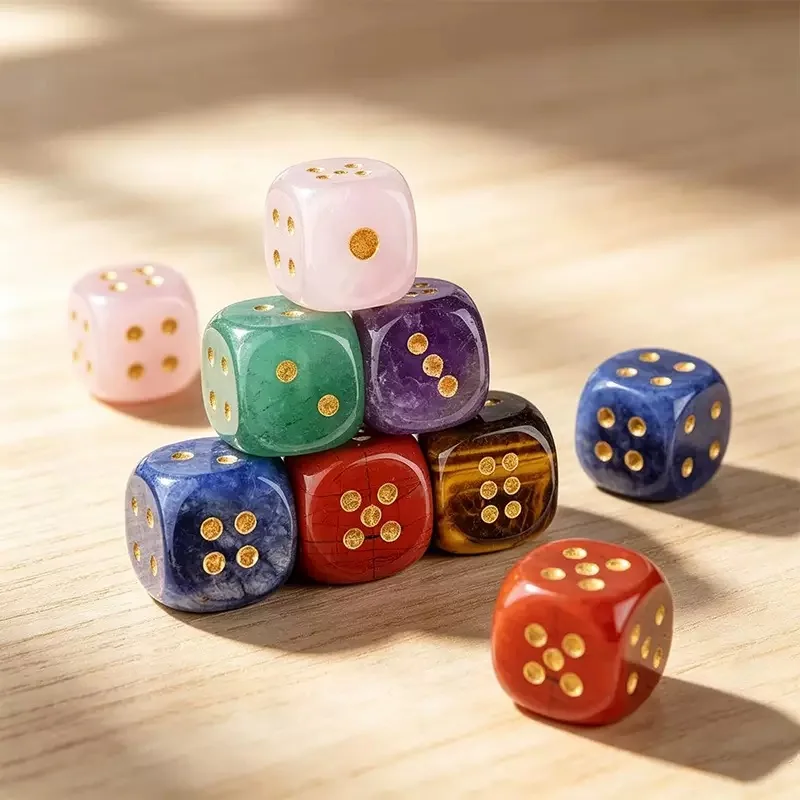
Roleplaying games built on a single die roll — D&D, Pathfinder — use the standard seven-piece polyhedral set: d4, d6, d8, d10, percentile d10, d12 and d20. Dice pool games work completely differently: Warhammer 40,000 and Age of Sigmar roll handfuls of six-sided dice, Shadowrun uses large d6 pools, and World of Darkness games use d10 pools. Call of Cthulhu is percentile-based. Most board games need only a few d6. For anyone stocking or commissioning dice, the practical split is this: RPG players buy one beautiful set, pool-game players buy twenty to forty matching dice of a single type — a completely different order shape.
Ask what dice a tabletop game needs and most answers describe a seven-piece polyhedral set. That is right for a specific family of games and wrong for a great many others. If you are buying dice for yourself the distinction saves you money; if you are stocking or commissioning them, it changes what you should make.
D&D and Pathfinder: the seven-piece set
Dungeons and Dragons, Pathfinder and most d20-system games use one standard set: d4, d6, d8, d10, a percentile d10 marked in tens, d12 and d20. The d20 does the heavy lifting — attacks, saves, skill checks — and the smaller dice mostly roll damage. Many players own several sets, partly for spells that roll a lot of dice at once, mostly because collecting them is half the hobby. This is the format nearly all gemstone dice are sold in, and it is bought one set at a time as a personal object.
Warhammer and wargaming: piles of d6
Warhammer 40,000, Age of Sigmar and most miniature wargames use six-sided dice and nothing else, but they use a lot of them. A single unit attacking can mean rolling ten, twenty or more dice at once, and a player will typically carry thirty or more matching d6. What matters to these players is not variety but consistency: the dice should look identical, be easy to read at a glance across a table, and roll fast. This is a fundamentally different purchase from a collector buying one polyhedral set.
Dice pool systems: Shadowrun and World of Darkness
- Shadowrun — large d6 pools; players routinely roll a dozen or more at once.
- World of Darkness games (Vampire, Werewolf) — d10 pools, counting successes against a target number.
- Both reward matching sets of a single die type in quantity, not mixed polyhedral sets.
- Readability matters more than in d20 games, because you are scanning many dice for successes at speed.
Call of Cthulhu and percentile systems
Call of Cthulhu and other percentile games resolve on a roll of 1 to 100, made with two ten-sided dice — one marked 00 to 90 for tens and one marked 0 to 9 for units. Players also need a handful of d6 and d8 for damage. The practical point for a seller is that percentile pairs are a legitimate small product in their own right, and they are frequently sold as a matched two-dice set rather than as part of a seven.
Board games, family games and dice games
The overwhelming majority of board games use ordinary six-sided dice, usually between one and six of them. Yahtzee uses five, Liar’s Dice five per player, backgammon two plus a doubling cube, and most modern eurogames one or two. This is the largest dice market by volume and the least glamorous, and it is where a beautiful upgrade sells well: replacing the flimsy plastic dice that came in the box with a matched pair of polished stone is an easy, giftable purchase that needs no knowledge of any RPG.
Blood Bowl and games with special dice
Some games need dice that are not numbered at all. Blood Bowl uses block dice marked with outcome symbols rather than pips, and many modern board games ship custom symbol dice — resource icons, hit and miss faces, direction arrows. These cannot be bought off the shelf; they have to be made. For a manufacturer this is straightforward, because engraving a symbol is no harder than engraving a number, but it does mean the game publisher must supply artwork.
What this means if you are stocking dice
- RPG collectors — sell single seven-piece sets, emphasise beauty and material. One set per purchase, high perceived value.
- Wargamers — sell matched d6 in quantity, twenty to forty at a time, emphasising consistency and readability.
- Board gamers and gift buyers — sell pairs or small groups of d6 as an upgrade, with packaging that makes them giftable.
- Publishers — need custom symbol dice, which means artwork, tooling or engraving setup, and a genuine minimum order.
Where gemstone fits
Natural stone works across all of these, but the order shape differs. A gemstone seven-piece set is a collector’s object and sells one at a time. Gemstone d6 sold in matched quantity suits wargamers and board gamers, and because they are cut from the same stone batch they look consistent in a way mixed sources cannot match. Our minimum is 10 sets for gemstone dice, and we engrave symbols as readily as numbers — pips, faction icons, or your own artwork. If you are not sure which format fits your customers, tell us what they play and we will suggest a mix.
Frequently asked questions
What dice do I need for D&D?
The standard seven-piece polyhedral set: d4, d6, d8, d10, a percentile d10 marked in tens, d12 and d20. Pathfinder and most d20-system games use the same set.
What dice does Warhammer use?
Six-sided dice only, but many at once. Players typically carry thirty or more matching d6, because a single unit attacking can mean rolling ten or twenty dice in one go.
What is a dice pool game?
One where you roll a handful of the same die type and count successes rather than reading a single result. Shadowrun uses large d6 pools, and World of Darkness games such as Vampire use d10 pools.
What dice does Call of Cthulhu need?
Percentile dice — two ten-sided dice, one marked 00 to 90 and one 0 to 9 — plus a few d6 and d8 for damage.
Can you make dice with symbols instead of numbers?
Yes. Engraving a symbol is no harder than engraving a number — faction icons, outcome symbols, resource icons or your own artwork. Supply vector artwork and we will sample it before the full run.
Which format should I stock for a general audience?
Seven-piece sets for RPG collectors, matched d6 in quantity for wargamers, and giftable pairs or small groups of d6 for board gamers — three different order shapes from the same product line.
Related guides
Have a custom dice project?
Send us your spec sheet — we'll reply with a detailed quote within 24 hours.
Get a Free Quote