
Are Gemstone and Metal Dice Balanced? What Buyers Should Know
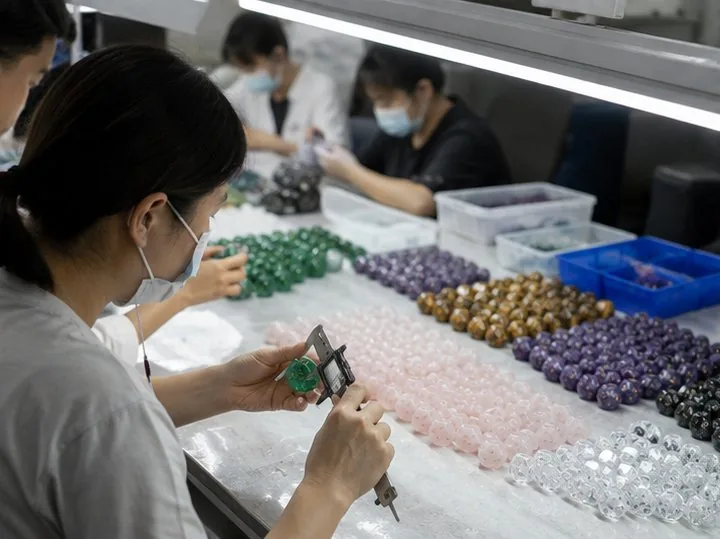
Gemstone and metal dice are balanced enough for normal play, but no hand-finished die is perfectly fair the way a casino-grade precision d6 is. Natural stone has internal density variations and metal dice carry hollow or engraved areas, so tiny biases exist — small enough that players will not notice in practice. For collectors and tabletop play this is fine; for competitive or statistical fairness, moulded plastic precision dice are the stricter choice. Good QC keeps custom dice consistent and true.
Buyers of premium dice often ask a fair question: if a die is carved from stone or cast in metal, does it still roll fairly? The honest answer is nuanced. Balance depends on material and manufacturing, and there is a real difference between "fair enough for play" and "laboratory-perfect." Here is what actually affects dice balance and what to expect from each material.
What makes a die balanced?
A perfectly balanced die has its centre of mass exactly at its geometric centre, so every face has an equal chance. In practice, factors like uneven material density, deep engraving on one side, air pockets, and rounding all shift the centre of mass slightly. The question is not whether a die is perfect, but whether any bias is large enough to matter in real rolling.
Balance by material
- Acrylic and resin — moulded acrylic is the most consistent; resin varies a little more because it is hand-poured, but both roll fairly for play.
- Metal — dense and consistent, though hollow designs and deep engraving can introduce a small bias; solid metal dice are very stable.
- Gemstone — natural stone has internal density variation and inclusions, so gemstone dice have the most natural variation, while still rolling fairly for tabletop use.
- Precision plastic — casino-grade precision d6s are the fairest of all, machined to tight tolerances, but they are a different product from decorative custom dice.
Does the small bias matter?
For tabletop gaming, collecting, and display, the tiny biases in gemstone and metal dice are not noticeable over normal play — the randomness of rolling swamps them. If you need statistically strict fairness, for competitive play or probability testing, moulded precision dice are the right tool. Most players buy premium dice for the look and feel, and treat perfect fairness as a separate need.
How we keep custom dice consistent
We control balance with consistent moulds and cutting, even wall thickness on hollow metal designs, careful engraving depth, and QC sorting that checks sets for obvious defects and consistency before they ship. This keeps custom dice as fair and uniform as the material allows. Tell us your priorities — looks, weight, or fairness — and we will recommend the right material and construction.
Frequently asked questions
Are gemstone dice fair to roll?
Yes, for tabletop play and collecting. Natural stone has small internal density variations, so gemstone dice are not laboratory-perfect, but any bias is too small to notice in normal rolling.
Are metal dice balanced?
Solid metal dice are dense and stable. Hollow designs and deep engraving can add a tiny bias, but for play they roll fairly. Good QC and even wall thickness keep them consistent.
Which dice are the most fair?
Casino-grade precision plastic d6s are the fairest, machined to tight tolerances. Decorative custom dice in resin, metal, and gemstone are fair for play but are made for look and feel rather than statistical perfection.
Related guides
Have a custom dice project?
Send us your spec sheet — we'll reply with a detailed quote within 24 hours.
Get a Free Quote