
Which Board Games Are Worth Upgrading to Stone Dice?
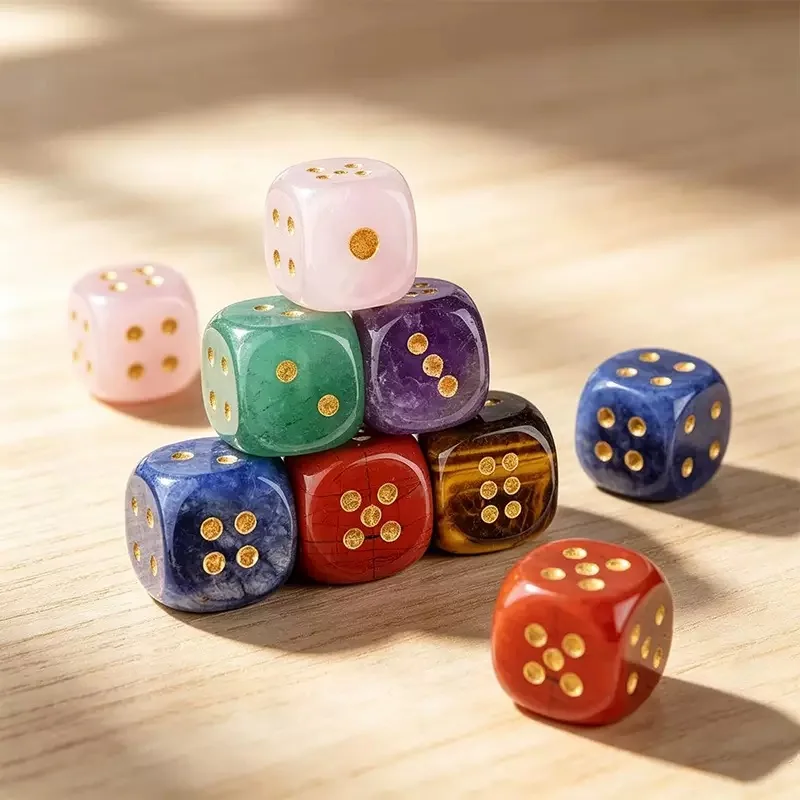
Almost every mainstream board game uses ordinary six-sided dice, and the ones included in the box are usually the cheapest component in it. Upgrading is worth it where dice are rolled constantly and handled by everyone: Yahtzee needs five, Farkle six, Liar’s Dice five per player, Catan and Monopoly two each, Risk five, and backgammon two per player plus a doubling cube. 16mm is the standard board game size; backgammon runs smaller at 12 to 14mm so the dice fit the cup and the board. A matched pair or set of polished stone dice is one of the easiest gifts to give a board gamer, because it needs no knowledge of which games they own.
Board game publishers spend their component budget on the board, the miniatures and the art. The dice are usually thin, hollow, and the first thing a serious player replaces. That makes dice upgrades one of the most reliable small purchases in the hobby — and, for a retailer, one of the easiest things to sell to someone who is not otherwise a dice person.
How many dice does each game need?
- Yahtzee — five d6, rolled constantly. One of the most satisfying upgrades there is.
- Farkle — six d6.
- Liar’s Dice / Perudo — five d6 per player, so a set scales with your group.
- Catan — two d6 (some editions add an event die).
- Monopoly — two d6.
- Risk — five d6 in two colours: three for the attacker, two for the defender.
- Backgammon — two d6 per player, plus a doubling cube.
- Bunco — three d6; Shut the Box — two.
What size should you buy?
16mm is the standard size for board game dice and the safe default for almost everything on that list. Backgammon is the exception and runs smaller, typically 12 to 14mm, so the dice fit comfortably in a cup and behave properly inside the board. Larger dice of 20mm and up look impressive and are easier to read across a table, but in games where you shake five or six in a cup they become unwieldy. If you are buying for someone else and cannot ask, 16mm is the right guess.
Which upgrades do people actually notice?
The games where dice are rolled dozens of times per session and passed around the table. Yahtzee, Farkle and Liar’s Dice top that list, because the dice are effectively the whole game and everyone handles them. Catan and Monopoly benefit too, though each player rolls less often. Games where dice are incidental — a single roll to break a tie — are not worth the spend. The test is simple: if the dice are in someone’s hand most of the evening, upgrading them changes how the game feels.
Why stone instead of metal or resin?
Weight without harshness. Metal dice are heavier still and very loud, and they dent wooden boards; resin is light and closer to what came in the box. Natural stone sits between them: substantial in the hand, cool to the touch, and every die slightly different because the grain is real. For a game played socially around a table, the tactile quality is most of the appeal — people pick the dice up and comment on them, which is not something a plastic d6 ever prompts.
What to watch out for
- Use a tray, a cup or a felt-lined board — stone on a bare wooden table is loud and can chip the dice over time.
- Check the pips or numerals are ink-filled; unfilled engraving on stone is hard to read in normal lighting.
- Buy dice from one matched batch so a set of five or six looks intentional rather than assembled.
- For two-colour games such as Risk, plan the colours up front rather than buying twice.
Why this sells well as a gift
A matched set of polished stone d6 requires no knowledge of which games the recipient owns — they will fit something. It looks far more expensive than it costs, it needs no explanation, and it photographs well enough that it sells from a shelf without a pitch. For a shop, it also crosses categories: it sits equally naturally in a game store, a gift shop, or next to crystals, which few products do.
Stocking them
If you are selling rather than buying, the useful formats are a pair for Catan, Monopoly and backgammon, a five-dice set for Yahtzee and Liar’s Dice, and a six-dice set for Farkle — with the counts on the packaging so the customer instantly knows what it is for. Our minimum is 10 sets for gemstone dice, and dice can be cut from one stone lot so a five or six piece group stays visually consistent. Tell us the counts and colours you want and we will quote the mix.
Frequently asked questions
How many dice does Yahtzee need?
Five six-sided dice. Because they are rolled constantly and handled by every player, Yahtzee is one of the most worthwhile games to upgrade.
What size dice do board games use?
16mm is the standard and the safe default for almost every mainstream board game. Backgammon is the exception, running smaller at 12 to 14mm so the dice fit the cup and the board.
How many dice does Liar’s Dice need?
Five per player, so the total scales with your group — a five-dice set per person is the usual purchase.
Are stone dice too heavy for board games?
No, and the weight is the main appeal. They are heavier than plastic but far less harsh than metal, which is loud and can dent a wooden board. Use a tray, cup or felt-lined surface.
Which board game upgrades are not worth it?
Games where dice are incidental — a single roll to break a tie. The upgrade is worth it where dice are in someone’s hand most of the evening, such as Yahtzee, Farkle and Liar’s Dice.
Can I get a matched set of five or six dice?
Yes. Dice can be cut from one stone lot so a group stays visually consistent, which matters for five and six dice sets where mismatched pieces are obvious.
Related guides
Have a custom dice project?
Send us your spec sheet — we'll reply with a detailed quote within 24 hours.
Get a Free Quote