
Backgammon Dice: Sizes, the Doubling Cube, and Why Players Upgrade
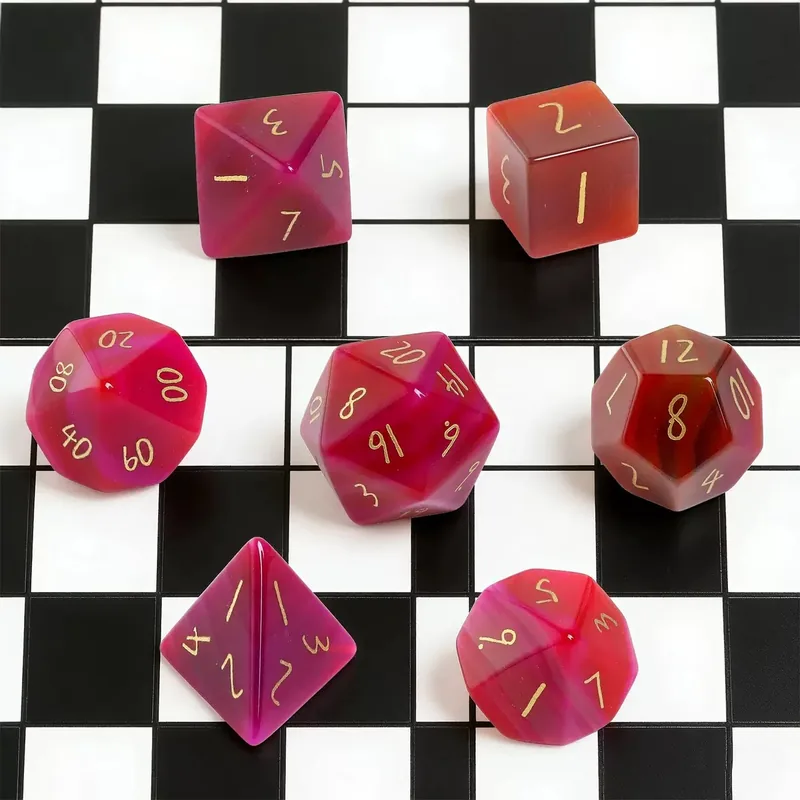
A backgammon set needs two dice per player — four in total — plus a doubling cube, which is a larger sixth-sided piece marked 2, 4, 8, 16, 32 and 64 that tracks the stake rather than being rolled. Backgammon dice are smaller than standard board game dice, usually 12 to 14mm, because they must roll properly inside the board and fit a cup. Tournament play often uses precision dice with sharp edges and tight tolerances. Backgammon is the classic home for premium dice, so a felt-lined board plus a matched stone pair is a natural upgrade — the felt matters, because stone on a bare hard board is loud and chips.
Backgammon is one of the oldest games still widely played, and it has dice conventions that differ from the rest of the board game world. If you are buying or stocking backgammon dice using board game assumptions, most of them will be slightly wrong.
How many dice does backgammon need?
Four playing dice — two per player, because each player rolls their own pair from their own cup rather than sharing. Plus the doubling cube, which makes a set of four dice and one cube. Sets are therefore usually sold as two matched pairs, and it is common for each player’s pair to be a different colour so that a die rolled into the wrong half of the board is obvious.
Why are backgammon dice smaller?
Because they are rolled from a cup into a confined board, not thrown across a table. Standard board game dice of 16mm are large for that job: they crowd the cup, and in a narrow board they are more likely to land cocked or hop onto the bar. The usual backgammon size is 12 to 14mm, and precision tournament dice are commonly half an inch, about 12.7mm. Smaller dice tumble properly in the shorter distance a backgammon roll actually travels.
What is the doubling cube?
It is not a die and it is never rolled. The doubling cube is a six-sided piece marked 2, 4, 8, 16, 32 and 64 that records the current stake. A player who believes they are ahead may offer to double before their roll; the opponent either accepts, turning the cube to the next value with themselves now owning it, or declines and forfeits the current stake. It is what turns backgammon from a race into a game of judgement, and it is why sets include a piece noticeably larger than the playing dice — commonly around 25mm or more, so its value is readable from across the board.
What are precision dice?
Dice manufactured to close tolerances with sharp, square edges and drilled pips filled flush so the weight stays even. They are used in tournament backgammon for the same reason casinos use precision dice: repeated play over long sessions is exactly the condition under which a small bias would show. For home and club play the distinction rarely matters, and most players choose dice on feel and appearance. It is worth knowing the term exists, because a buyer asking for precision dice is asking for a specific manufacturing standard, not simply a nice die.
Why backgammon suits premium dice
Backgammon has a long tradition of being played on beautiful equipment — inlaid wooden boards, leather cases, and dice chosen to match. It is a two-player game played slowly and socially, often with the same set for decades, which is the opposite of a game whose components are used once and shelved. That combination makes it the classic home for premium dice, and one of the few games where people genuinely notice and comment on what they are rolling.
Does stone work in a backgammon set?
Well, with one condition: the board should be felt or leather lined, which most quality boards are. Stone dice rolled onto a bare hard playing surface are loud, and over years of play the corners will take damage. On a felt-lined board they are close to ideal — the weight suits the short roll from a cup, they settle flat quickly rather than skidding, and a matched pair per player in contrasting stones looks the part on an inlaid board. Choose a stone with enough contrast in the pip fill to read instantly, because backgammon is read at a glance.
What to specify when ordering
- Size — 12 to 14mm for playing dice, rather than the 16mm board game standard.
- Four dice, usually as two matched pairs in contrasting stones or colours.
- A doubling cube, noticeably larger and marked 2, 4, 8, 16, 32, 64 rather than pips.
- Ink-filled pips with strong contrast, since the roll is read at speed.
- Rounded corners for a lined board; sharp edges only if the buyer specifically wants precision-style dice.
Frequently asked questions
How many dice are in a backgammon set?
Four playing dice — two per player, since each rolls their own pair from their own cup — plus a doubling cube, which is not rolled.
What size are backgammon dice?
Usually 12 to 14mm, smaller than the 16mm board game standard, because they are rolled from a cup into a confined board. Precision tournament dice are commonly half an inch, about 12.7mm.
What is the doubling cube used for?
It tracks the stake rather than being rolled. Marked 2, 4, 8, 16, 32 and 64, it is turned when a player offers to double and the opponent accepts, and it is what makes backgammon a game of judgement rather than a pure race.
What are precision backgammon dice?
Dice made to close tolerances with sharp square edges and pips filled flush so the weight stays even. They are used in tournament play, where long sessions would reveal any small bias.
Can you use stone dice for backgammon?
Yes, on a felt or leather lined board, which most quality boards have. On a bare hard surface they are loud and the corners will eventually chip. On a lined board the weight suits the short roll from a cup very well.
Should backgammon dice have sharp or rounded corners?
Rounded for normal play on a lined board — they settle quickly and survive better. Sharp edges belong to precision-style tournament dice, which is a specific manufacturing standard rather than a style choice.
Related guides
Have a custom dice project?
Send us your spec sheet — we'll reply with a detailed quote within 24 hours.
Get a Free Quote