
What Gemstone Dice Are Actually Like to Play With
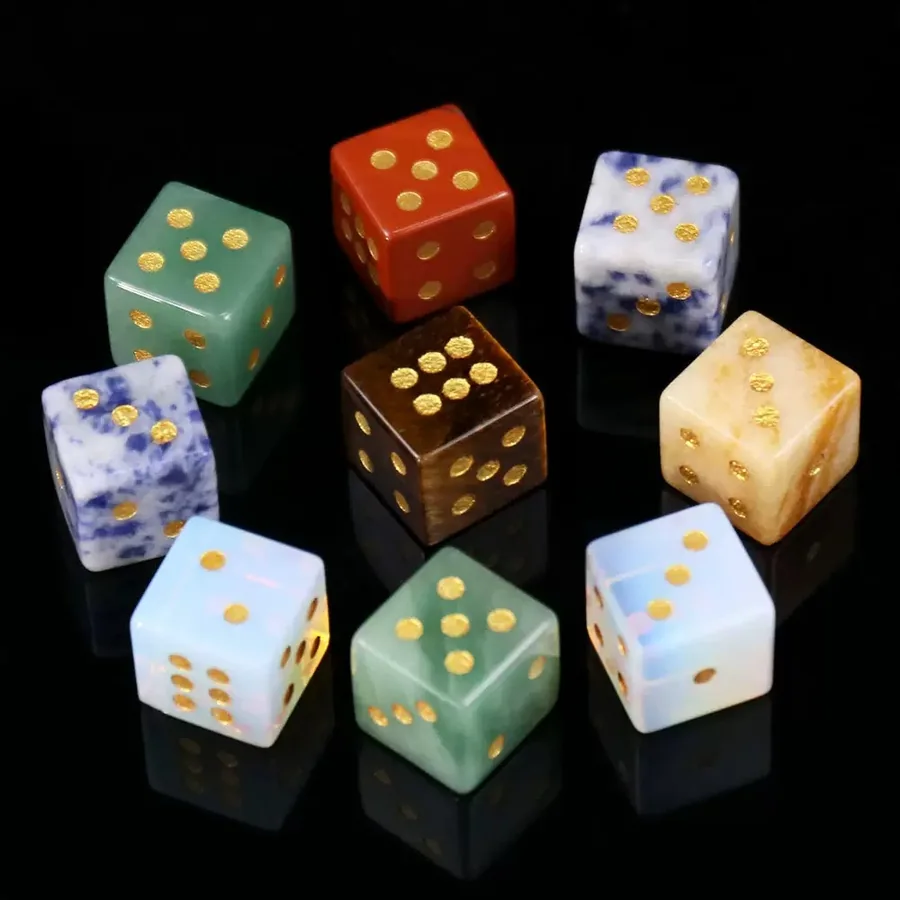
Gemstone dice feel substantially heavier than plastic, which is the main reason people love them — they land with weight and stay where they fall. The trade-offs are real: they are louder, they can chip if thrown hard onto a bare hard surface, they can mark a wooden table, and dark stones can be harder to read in dim light unless the engraving is ink-filled with good contrast. A dice tray solves almost all of it. They are gaming grade rather than casino grade, which means they roll fairly for tabletop play but are not precision-balanced, and that is normal for every non-casino die including plastic ones.
Most descriptions of gemstone dice are written to sell them. This one is written to set expectations, because a player who knows what stone dice do well and what they do badly is far happier with the purchase than one who finds out at the table.
What do they feel like?
Heavy, cold, and dense. A stone d20 weighs several times what an equivalent plastic one does, and it stays cold in your hand for a while, which plastic never manages. The practical effect is that they land and stop rather than skittering off the table, and the roll feels deliberate. Almost everyone who buys stone dice buys them again, and the weight is the reason. If you have only ever used plastic, the first roll is genuinely a different experience.
Are they loud?
Yes, noticeably. Stone on wood is a sharp crack rather than a clatter, and a handful of them is louder still. In a quiet room, at a shop table, or in a game being recorded, this matters. A dice tray with a felt or leather base takes care of it and is the single accessory worth buying alongside a stone set.
Will they chip?
They can. Natural stone is hard but brittle, and the corners take the impact. Chipping is rare in normal play on a soft surface and much more likely if you throw hard onto bare wood, stone or glass, or if dice collide repeatedly in a large handful. Softer and more fractured stones are more vulnerable than dense ones like obsidian, tiger eye and agate. The honest summary: treat them as nice objects rather than disposable ones, roll them in a tray, and they will outlast plastic by years.
Will they damage the table?
On a bare wooden table, over time, possibly — stone is harder than most tabletops. This is rarely a problem in practice because most people who buy stone dice also roll them in a tray or on a mat, but it is worth knowing before rolling a full set across someone else’s dining table. It is also a fair reason for a host to ask for a tray, and not a reflection on the dice.
Can you read them easily?
It depends entirely on the engraving, not the stone. Numerals cut into stone and left unfilled are hard to read in normal lighting. Ink-filled engraving — gold, white or black depending on the stone — is what makes them legible, and dark stones with gold or white fill read best. If you are choosing a set for actual play rather than display, check that the faces are filled and that the contrast survives dim lighting, which is how most games are actually lit.
Do they roll fairly?
For tabletop play, yes. Gemstone dice are cut and ground to accurate flat-faced geometry and inspected before they ship. They are gaming grade, not casino grade — casino dice are made to tolerances measured in thousandths of an inch, are transparent so tampering is visible, and get retired after hours of use. No hobby die, plastic included, meets that standard. Natural stone also has internal density variation that a moulded plastic die does not. In practice that is not detectable over a normal game, and it is worth remembering that mass-market plastic dice have well-documented biases of their own from the moulding process.
Should a DM allow them?
Almost all do, and the usual conditions are practical rather than suspicious: roll in a tray, do not roll off the table, and re-roll cocked dice. If a table is strict about fairness, the fair standard to apply is the same for everyone — a stone d20 is no less trustworthy than the plastic set a player bought in a shop. Where a group does object, it is nearly always about noise and table damage, both of which a tray fixes.
Who should not buy them?
- Anyone who rolls hard onto bare hard surfaces and will not use a tray.
- Players in dice pool games who want to throw thirty dice at once without a tray — the collisions are what chip stone.
- Anyone needing a spare set to lend out and not worry about.
- Anyone who needs maximum readability in very dim light and does not want ink-filled faces.
Getting the most out of a set
- Use a tray or a padded mat — it fixes noise, chipping and table damage in one purchase.
- Store them in a pouch or a foam-lined box rather than loose in a bag with keys and other dice.
- Clean with a soft dry cloth; avoid ultrasonic cleaners and harsh solvents, which can affect ink fill.
- Choose ink-filled faces with real contrast if the set is for playing rather than displaying.
- Expect natural variation — grain, colour and inclusions differ from piece to piece, which is the point of real stone.
Frequently asked questions
Do gemstone dice chip easily?
Not in normal play on a soft surface. They can chip if thrown hard onto bare wood, stone or glass, or when many dice collide in a large handful. Denser stones such as obsidian, tiger eye and agate hold up best, and a dice tray largely eliminates the risk.
Are gemstone dice fair?
For tabletop play, yes. They are cut to accurate flat-faced geometry and inspected. They are gaming grade rather than casino grade, which is also true of every plastic hobby die — casino dice are a separate manufacturing standard.
Are stone dice too loud?
They are noticeably louder than plastic, a sharp crack rather than a clatter. A dice tray with a felt or leather base solves it and is the accessory most worth buying alongside a stone set.
Will gemstone dice damage my table?
On bare wood, potentially, since stone is harder than most tabletops. Rolling in a tray or on a mat prevents it entirely.
Are gemstone dice hard to read?
Only if the engraving is not ink-filled. Filled faces — gold or white on dark stone especially — read well even in the dim lighting most games happen in. Unfilled engraving on stone is genuinely hard to read.
Will a DM let me use them?
Almost always. The usual conditions are practical: roll in a tray, keep them on the table, re-roll cocked dice. A stone die is no less trustworthy than a shop-bought plastic one.
Related guides
Have a custom dice project?
Send us your spec sheet — we'll reply with a detailed quote within 24 hours.
Get a Free Quote