
Custom Gemstone Dice Cost: What Drives the Price and How to Lower It
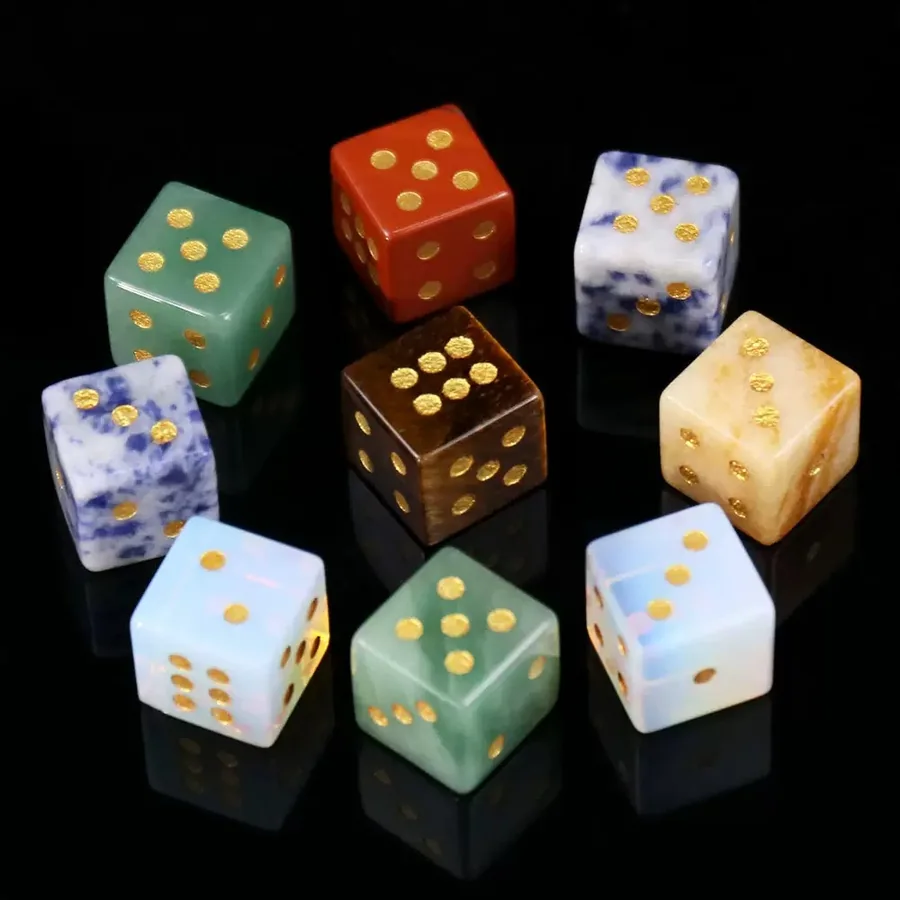
Gemstone dice sit at the premium end of the dice market, and buyers often ask why. The short answer: they are made from real stone, cut and finished largely by hand, with lower yields than moulded resin. Understanding what drives the cost helps you plan a product that hits your target price. Here is the breakdown, plus levers you can pull to lower unit cost.
What drives the cost
- Stone type: rarer or harder stones cost more in raw material and take longer to cut. Common stones (obsidian, agate) are more affordable than scarcer ones.
- Hand labour: unlike resin poured into a mould, each stone die is cut, ground, faceted, and polished — much of it by hand. This is the biggest cost driver.
- Yield and breakage: stone cracks and chips during working, so some material is lost. Lower yield means higher cost per finished die.
- Engraving and inking: number engraving plus logos or symbols, then ink filling, add labour per face.
- Packaging: branded boxes, foam trays, and inserts add cost but raise perceived value.
- Order volume (MOQ): unit price drops as quantity rises, because setup and handling are spread across more sets.
Why gemstone costs more than resin
A resin set is poured into a reusable mould in minutes; a gemstone set is worked from solid stone over a much longer cycle, with real material loss. That labour and yield gap is why gemstone dice are a premium line rather than a budget one — and why they command higher retail prices.
How to lower your unit cost (without cutting quality)
- Order more per run: moving from 100 to 500+ sets meaningfully lowers unit price. Combine SKUs (different stones) into one larger order to reach a better tier.
- Choose accessible stones: obsidian, agate, and tiger eye give a genuine gemstone product at a lower material cost than scarce stones.
- Keep engraving simple: standard numerals cost less than intricate custom symbols on every face; add a logo on the d20 only rather than every die.
- Buy factory-direct: skipping a trading company removes a 20–40% markup — the single biggest saving for many buyers.
- Right-size packaging: a clean printed box can look premium without the cost of elaborate custom tooling.
What not to cut
Do not save money by switching to dyed glass while still calling it "natural gemstone", and do not skip quality inspection — chipped edges or illegible faces cause returns that cost far more than they save. Lower cost by volume and smart specification, not by misrepresenting the product.
Getting an accurate quote
To get real pricing rather than a vague estimate, send your target stone(s), quantity per tier (for example 100 / 300 / 500 sets), die size, engraving and logo requirements, and packaging. CuiShen quotes factory-direct with tiered pricing so you can see exactly how unit cost changes with volume.
Frequently asked questions
Why are gemstone dice so expensive?
Because they are cut from real stone largely by hand, with material lost to cracks and chips along the way. That labour and lower yield — versus resin poured into a reusable mould — is what makes gemstone dice a premium product.
How can I make custom gemstone dice cheaper?
Order larger volumes to reach better price tiers, choose more accessible stones (obsidian, agate, tiger eye), keep engraving simple, and buy factory-direct to avoid a trading-company markup.
What is the minimum order for custom gemstone dice?
At CuiShen the standard MOQ is 10 sets across stone types, with unit price improving at 500+ and higher volumes. You can mix stones to reach a tier.
Related guides
Have a custom dice project?
Send us your spec sheet — we'll reply with a detailed quote within 24 hours.
Get a Free Quote